If you want to teach your puppy sit, stay, and come correctly, the single most important thing to know is this: the order matters. These three commands work as a connected system, and when you teach them in sequence, each one makes the next easier to learn. The result is a puppy that sits when asked, waits patiently until released, and comes back to you reliably — skills that make daily life easier and keep your dog safer for years to come.
No special equipment is required to get started. You need small, high-value treats, a quiet space, and five minutes. That is genuinely enough.
Disclosure: This article contains affiliate links. If you purchase through these links, we may earn a small commission at no extra cost to you. As an Amazon Associate, we earn from qualifying purchases.
Why the Order You Teach Sit, Stay, and Come Actually Matters
Understanding how to teach a puppy sit, stay, and come as a sequence — rather than three disconnected skills — is what separates fast learners from puppies that stall out after the first command.
Sit is the starting point because it is the behavior most puppies offer naturally. Early success builds engagement and trust between you and your puppy.
Stay requires sit to already be solid. If your puppy does not yet understand sit as a reliable default, adding stay creates confusion about what either cue means.
Come (also called the recall) requires impulse control — which stay builds — and a strong positive association with returning to you. That trust takes time to develop, which is why come is taught last.
Session length matters too. For a young puppy, aim for 3–5 minutes per session, two or three times a day. Their attention spans are genuinely short. Stopping while your puppy is still engaged and succeeding is far more productive than pushing through disengagement. If you find your puppy checking out before the session ends, the advice in Puppy Ignores You During Training: How to Get Focus Back Fast will help you troubleshoot.
A treat pouch worn on your hip makes short sessions faster and more consistent — you are not fumbling with a bag or a pocket, and the pouch appearing can become its own signal that training is starting.
How to Teach a Puppy to Sit — Step One of Sit, Stay, Come
This is the foundation of puppy obedience training basics. Get this right and everything else becomes easier.
1. Choose a quiet, low-distraction space. A kitchen or hallway works well. The backyard is too interesting at this stage. Your puppy needs to be able to focus on you without competing stimuli.
2. Hold a small treat at your puppy’s nose level and slowly move it back over their head. As the nose follows the treat upward, the hindquarters drop naturally. This technique is called luring — you are guiding the behavior, not forcing it. Treats should be pea-sized or smaller for a young puppy.
3. The moment their bottom touches the floor, mark the behavior and deliver the treat immediately. The mark — either a clicker click or a clear verbal marker like “yes” — must happen at the exact moment of the sit. This is what tells your puppy precisely which behavior earned the reward. A dog training clicker is a useful tool, but a consistent verbal marker works just as well. Neither is required; both work. Understanding why positive reinforcement works better than corrections for puppies — with real examples — can help you stay consistent with reward-based marking from the very first session. If you want a deeper look at the principles behind marker training, Dog Behavior Problems and How to Solve Them Without Punishment covers the fundamentals in detail.
4. Repeat 5–10 times per session, then start fading the lure. Once your puppy is sitting reliably with the treat in your hand, begin using the same hand motion with an empty hand and treat from your other hand or pocket. This prevents your puppy from only responding when they can see food.
5. Add the verbal cue “sit” only after the behavior is happening consistently. Say it once, calmly, just before the hand motion. If your puppy does not respond, do not repeat the cue. Quietly reset and try again. Repeating cues teaches your puppy that the first cue is optional.
What success looks like: Your puppy sits within two seconds of the cue, without a lure, in a quiet room. Most puppies reach this point within 3–5 short sessions.
How to Teach Stay Once Sit Is Solid
Stay is not a separate command so much as an extension of sit. The goal is teaching your puppy that sit means “remain seated until I release you” — not “touch your bottom to the floor and then do whatever.”
1. Ask for a sit and confirm your puppy is settled. Do not rush past this. If the sit looks shaky, practice a few more repetitions before adding any duration.
2. Pause for one second, then mark and treat. One second. Not ten. You are teaching the concept of duration in the smallest possible increment first.
3. Gradually extend the pause — two seconds, then three, then five. If your puppy breaks the sit, say nothing. Quietly reset, and go back to a duration you know they can hold. Never scold a broken stay. Your puppy is not being stubborn — they just need more practice at a shorter duration.
4. Introduce a release word. Choose “okay” or “free” — something you do not accidentally say in daily conversation. This word tells your puppy that stay is over. Without a release cue, your puppy learns to self-release, and stay becomes unreliable.
5. Add distance only after duration is solid. Take one step back, return to your puppy, mark and treat. Build to several steps before adding any distractions.
6. Follow the three D’s in order: Duration, then Distance, then Distraction. Never train more than one D at a time. If you add a distraction, reduce the duration and distance back to easy levels.
What success looks like: Your puppy holds a sit-stay for 10–15 seconds at a distance of a few feet in a familiar room, releasing only when you give the cue. This typically takes 1–2 weeks of consistent short sessions.
How to Teach Puppy Come — The Most Important Command You Cannot Rush
Recall is the command most commonly undermined before it is ever fully taught. When you teach puppy sit, stay, and come as a system, come gets the most time and the most care — because it carries the most real-world safety value.
1. Never use “come” for anything your puppy finds unpleasant. Ending playtime, bath time, nail trims — do not call your puppy for these things. If you need to do something your puppy dislikes, go and get them. Protect the recall cue by keeping it associated only with good outcomes.
2. Start with your puppy close to you. Crouch down, open your arms, say “come” in a bright and happy voice, and make arriving at you feel like the best thing that could happen — enthusiastic praise, a high-value treat, real excitement.
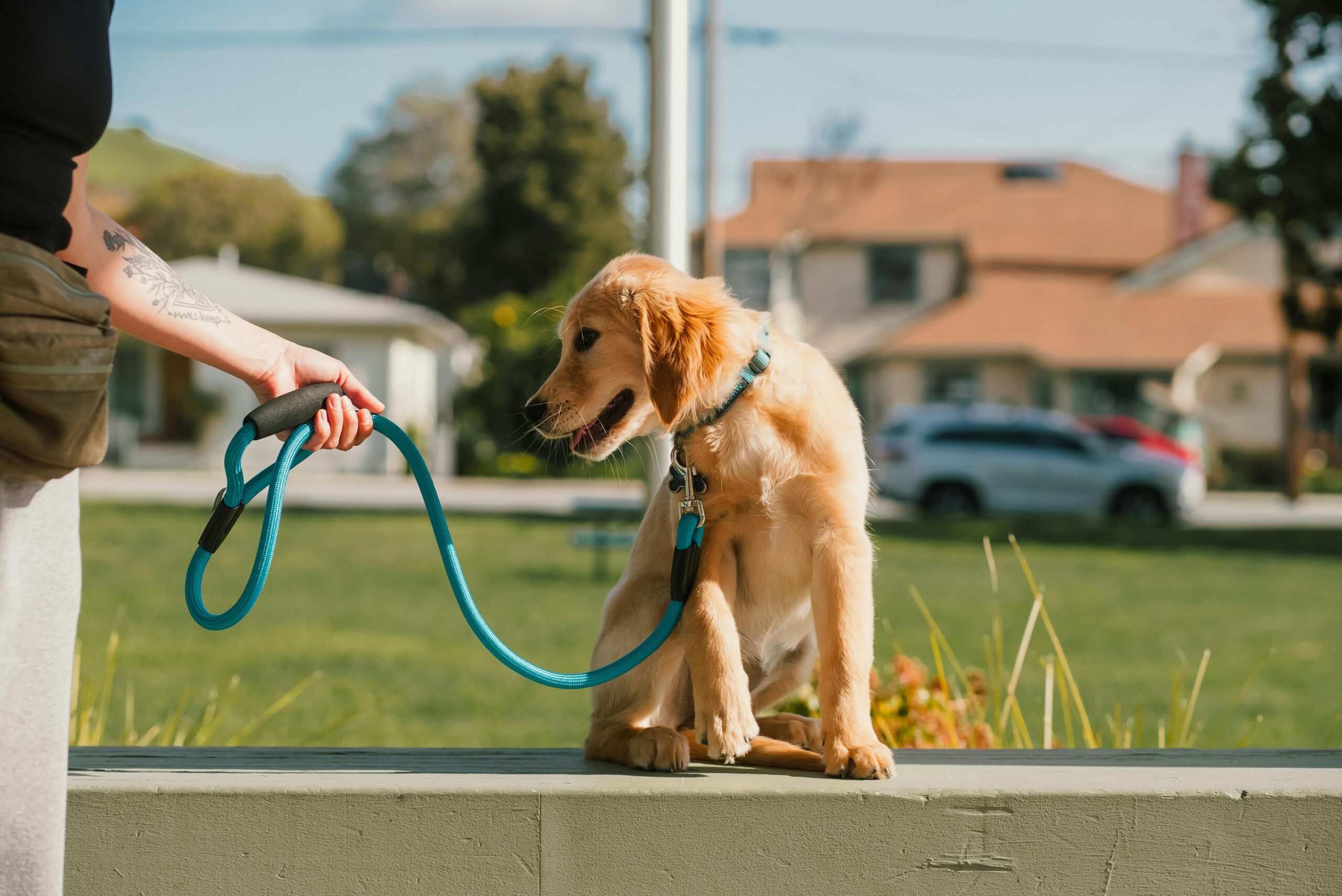
3. Build distance gradually in a safe, enclosed space. A long training leash of 15–20 feet used in a yard or garden allows you to practice recall at a real distance while maintaining safety. This is not a restraint — it is a safety net while the behavior is still being built. Never use a retractable leash for this; a flat long line gives you control without tension.
4. Reward every single recall during the learning phase. Coming to you should never result in a neutral or negative outcome. High-value rewards — small pieces of real chicken, cheese, or soft commercial training treats — work significantly better than kibble for this step. The recall needs to compete with everything else in your puppy’s environment.
5. Practice in different rooms and settings. Recall must generalize. Practice in the kitchen, the hallway, the garden, a friend’s house. Vary the context consistently before ever testing it off-leash in an open or unfamiliar area.
6. If your puppy does not come, do not repeat the cue or chase them. Move away from your puppy, make yourself interesting — crouch down, make sounds, act excited — and reward when they follow. Chasing teaches your puppy that running away starts a game.
What success looks like: Your puppy turns and moves toward you reliably when called, across multiple familiar locations, before being tested with distractions or off-leash freedom in open spaces.
Putting Sit, Stay, and Come Together: Real-Life Practice
Once each behavior is reliable on its own, begin combining them in short practical sequences: ask for sit → stay → come. Keep it short and successful.
Real-life applications come quickly:
- Sit before the leash goes on
- Stay while you open the front door
- Come when called away from the food bowl or another dog
When you start adding distractions — another person walking through the room, a toy on the floor — reduce duration and distance back to easy levels. Your puppy is not failing; the environment just got harder, and the criteria need to match.
Reliability takes weeks to months, not days. Five minutes a day of teaching your puppy sit, stay, and come consistently beats one long session per week every time.
Common Mistakes When You Teach Puppy Sit, Stay, and Come
These are the patterns that slow progress the most — and the good news is that all of them are easy to correct once you know to look for them.
- Repeating the cue when the puppy doesn’t respond — this teaches the first cue is optional; say it once, reset if needed
- Saying “sit-stay” as a compound cue — sit should already mean remain seated; adding “stay” as a suffix creates confusion about what either word means
- Calling the puppy for unpleasant things — this poisons the recall cue faster than almost anything else
- Running sessions too long — a puppy that has mentally checked out is not learning; end on a success before that happens. See Puppy Ignores You During Training: How to Get Focus Back Fast for strategies to keep engagement high
- Skipping the release word — without it, stay has no clear endpoint and your puppy will self-release
- Introducing distractions too early — always drop back to an easier criterion when the environment changes
For broader guidance on correcting behavior gently and effectively, Dog Behavior Problems and How to Solve Them Without Punishment covers force-free principles in depth.
Closing
The sequence is simple: sit first, stay second, come last — and come requires the most patience and the most consistently positive associations of the three. A puppy reliably performing all three in familiar, low-distraction settings by 12–16 weeks is well ahead of the curve. From here, every future behavior — loose-leash walking, leave it, waiting at the door — builds on the communication channel you have already opened. Keep sessions short, stay consistent, and trust the process.
Frequently Asked Questions
At what age should I start teaching my puppy sit, stay, and come? You can begin as early as 7–8 weeks old. Young puppies have short attention spans, but they are already capable of learning simple behaviors through luring and reward. The earlier you start building positive associations with training, the better.
How long should puppy training sessions be? For puppies under 16 weeks, 3–5 minutes per session is ideal. Two or three short sessions spread throughout the day is more effective than one longer session. Always end while your puppy is still engaged and succeeding.
What treats work best for puppy training? Small, soft, high-value treats work best — think pea-sized pieces of real chicken, cheese, or commercial soft training treats. Kibble can work for easy behaviors in low-distraction settings, but for recall in particular, you need something your puppy genuinely values.
My puppy sits but won’t hold stay — what am I doing wrong? The most common cause is adding too much duration or distance too soon. Go back to a one-second pause and rebuild incrementally. Also check that you have introduced a clear release word — without one, your puppy has no way to know when stay is over, so they decide for themselves.
My puppy sits fine at home but not outside — is that normal? Completely normal. A behavior learned in one environment does not automatically transfer to a noisier, more stimulating one. This is called proofing, and it requires deliberately practicing in new locations at easier criteria — shorter durations, closer distances — until the behavior generalizes.
Can I teach sit, stay, and come at the same time? You can work on all three within the same week, but not within the same session while they are all new. Teach sit until it is reliable, then introduce stay as an extension of it. Begin come separately once stay has some foundation. Mixing all three before any of them are solid slows progress.
How do I know when my puppy is ready to practice recall off-leash in an open area? Your puppy is ready when they respond reliably in multiple familiar, enclosed locations with mild distractions present. If recall is inconsistent in your own backyard, it is not ready for a park. Build the behavior thoroughly on a long line before removing the safety net.
How do I teach come if my puppy already ignores me when called? Stop using the word “come” temporarily. You may have already weakened it by calling without rewarding, or by calling for unpleasant things. Choose a new recall cue, start from scratch in a low-distraction environment with very high-value treats, and rebuild the positive association from the beginning.

Dog Behavior & Training