By Mark Davies, Dog Health & Nutrition
Disclosure: This article contains affiliate links. If you purchase through these links, we may earn a small commission at no extra cost to you. As an Amazon Associate, we earn from qualifying purchases.
When the Diet Isn’t Working — and You Don’t Know Why
If you’ve cut your dog’s food, switched to a “light” kibble, and are weeks into the plan with nothing to show for it — you’re not alone. The dog weight loss mistakes owners make are some of the most common and least obvious errors in everyday dog care. That’s not a knock on anyone trying to do right by their dog. The problem is that canine metabolism doesn’t respond the way human intuition expects, and a few small errors can quietly cancel out real effort.
This isn’t a general overview of why weight matters. If you’re here, you already know your dog needs to lose weight and you’re already trying. What follows are five specific, fixable mistakes that stall progress or cause unintended harm — along with the clear corrections that actually move the needle. These are the dog weight loss mistakes owners make most often, and the ones that are easiest to overlook precisely because they seem like reasonable choices. It’s also worth understanding that sometimes weight gain itself is the first puzzle to solve — if you’re wondering Why Is My Dog Gaining Weight but Not Eating More — Common Causes and What to Do, ruling out underlying causes first can make your weight loss efforts far more effective.
Mistake 1: Eyeballing Portions — One of the Most Common Dog Weight Loss Mistakes Owners Make
Why it’s easy to miss
Most owners use a scoop or measuring cup by feel. If you’ve been doing it for years, it genuinely feels accurate. The cup is the cup. The scoop is the scoop.
What actually happens
Visual estimation is notoriously unreliable — and with dry kibble, it’s even worse. Kibble varies in shape, density, and size across brands and formulas. A “generous cup” can easily deliver 20–30% more calories than the label assumes. If your target is a 20% caloric reduction, a consistently overfilled scoop wipes that deficit out completely.
The correct approach
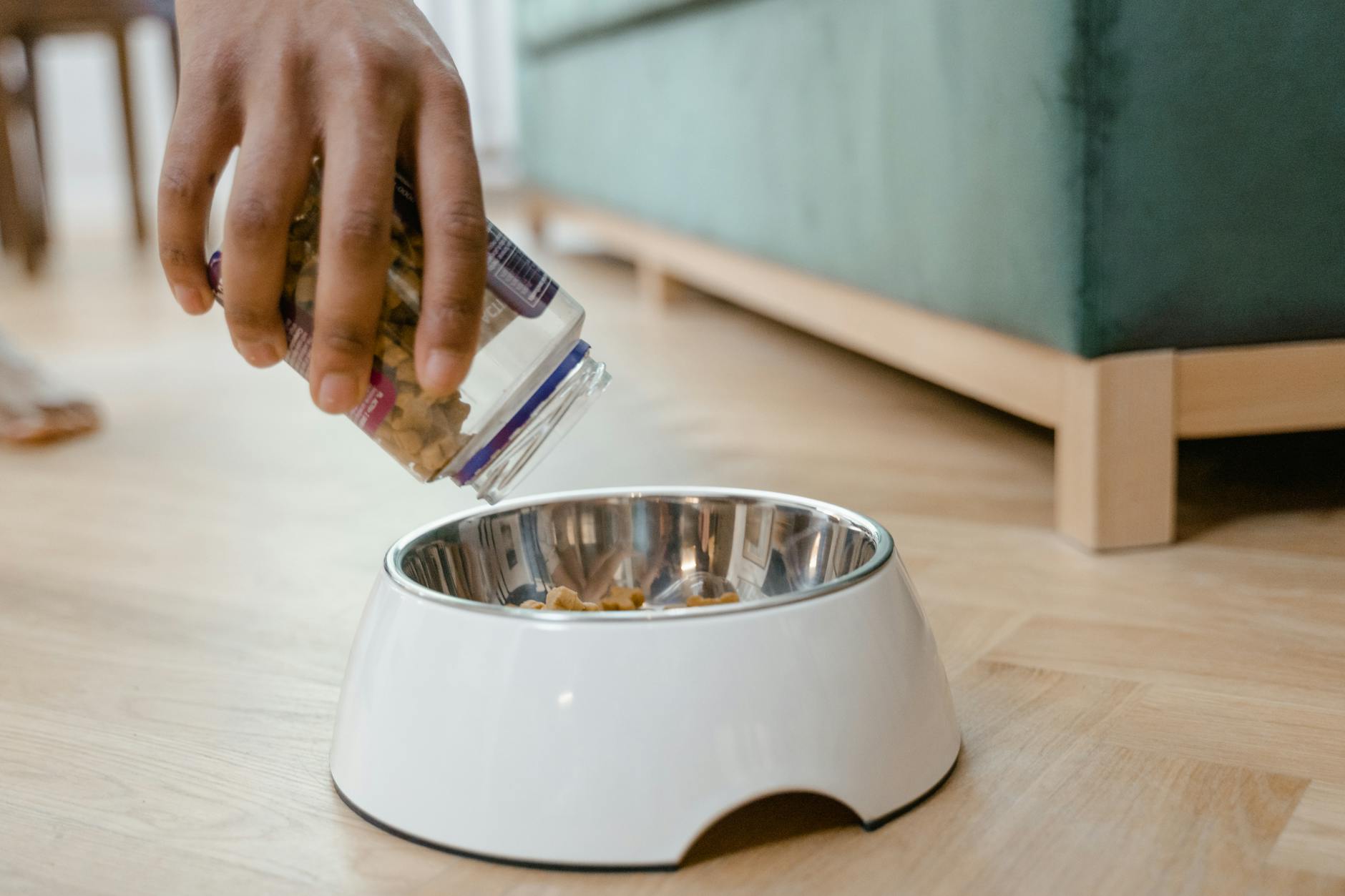
Use a kitchen scale and weigh in grams, not volume. A reliable kitchen scale costs under $20 and is the single highest-impact change most owners can make during an active weight-loss plan. [[Digital kitchen scale — affiliate link placeholder]] Weigh every meal at the start. Once you’ve got a consistent routine dialed in, spot-check weekly to make sure nothing has crept back.
The same applies when switching to a new food — kibble density changes, so the old scoop amount no longer means what it used to. For a full breakdown of how the different measurement methods compare, see our guide to measuring dog food portions accurately.
Myth to correct: “A little extra kibble isn’t a big deal.” At maintenance, maybe. During a calorie deficit, a consistent 20% overshoot erases the reduction entirely and explains why so many dogs on a “diet” show zero progress.
Mistake 2: Forgetting to Count Treats and Toppers — A Dog Weight Loss Mistake That Cancels Real Effort
Why it’s easy to miss
Treats feel separate from food. They’re small, given one at a time, and they’re tied to training, affection, or coaxing a picky eater — not feeding. Toppers feel incidental, just something added to make the bowl more appealing. Neither tends to appear in the mental tally of what the dog actually ate.
What actually happens
Treats and toppers can account for 10–30% of a dog’s daily caloric intake. For a dog on a 20% caloric reduction, three medium biscuits a day can cancel the entire deficit. A daily broth topper or spoonful of wet food adds up quickly over a week. This is one of the dog weight loss mistakes owners make that genuinely surprises people — because the treats themselves seem so small.
The correct approach
Account for all treats and toppers before portioning meals. If you know treats will be given during training or throughout the day, reduce the main meal by roughly that calorie amount. A rough approach: identify what treats you’ll use and look up their calorie count (most brands list this on the packaging or website), then subtract from the daily target.
During active weight loss, shift to low-calorie training treats — small, soft, and under 5 calories each. Single-ingredient freeze-dried raw food like chicken breast or beef liver works well because it can be broken into tiny pieces. You get a lot of training value out of very few calories. Many dogs also accept plain baby carrots, green beans, or cucumber slices as treats with no fuss.
For liquid toppers and broths, measure rather than pour freely — even low-sodium broth adds up across daily use.
Myth to correct: “Treats don’t count because they’re tiny.” Caloric impact scales with frequency, not piece size. Ten small treats given throughout the day add up exactly the same as fewer, larger ones.
Mistake 3: Cutting Calories Too Fast — a Dog Weight Management Mistake That Backfires
Why it’s easy to miss
When owners decide to act on their dog’s weight, the instinct is to act decisively. Cutting portions in half or immediately switching to the lowest-calorie food available feels like commitment. The logic is intuitive: bigger deficit, faster results.
What actually happens
Aggressive caloric restriction causes a dog’s body to break down lean muscle tissue alongside fat. This is genuinely counterproductive. Muscle drives metabolism, so losing it makes subsequent weight loss harder. A dog losing muscle rather than fat may also become lethargic, food-obsessed, or show coat and skin changes. The dog looks thinner but is in worse metabolic shape than before.
Safe, sustainable fat loss preserves lean tissue — and that requires a moderate, not aggressive, deficit.
The correct approach
Start with a 20–25% reduction from the dog’s current maintenance intake — not their target weight’s intake. The goal is a slow, steady loss of roughly 1–2% of body weight per month. That sounds frustratingly slow, but it’s the pace at which fat is preferentially burned rather than muscle.
Watch for signs that the reduction is too steep: unusual lethargy, changes in coat quality, or persistent food-driven anxiety. If you’re seeing any of those, ease back.
This is one of the places where a vet check-in is genuinely useful, not just a reflexive disclaimer. If you’re considering cutting more than 25% of current intake, or if the dog has any underlying conditions, a quick conversation with your vet before starting is worth the time.
Myth to correct: “The more you cut, the faster the results.” In dogs, aggressive restriction often trades fat loss for muscle loss — which slows metabolism and makes the problem harder to solve over time.
Mistake 4: Using the Bag Feeding Guide Without Adjusting — a Widespread Dog Diet Mistake
Why it’s easy to miss
The feeding guide is printed right there on the bag. It lists weights, it lists amounts, and it looks authoritative. Following it feels like the responsible thing to do. This is one of the dog weight loss mistakes owners make in complete good faith.
What actually happens
Bag feeding guides are designed for active, healthy dogs at or near their ideal weight. They represent maintenance calories for a lean dog at each listed weight. An overweight, low-activity dog following the bag guide verbatim is almost certainly eating enough to maintain or continue gaining — not enough to lose.
Some guides make this worse by instructing owners to feed based on current weight. If a dog is significantly overweight, that number will be much higher than what’s actually appropriate. It’s a circular problem: the more overweight the dog, the more food the guide suggests.
The correct approach
Use the bag guide as a rough starting reference, then adjust. For an overweight dog, the practical rule is to feed toward the ideal weight range rather than current weight, or apply a 20–25% reduction from current intake — whichever gives you a lower number.
Reassess every 3–4 weeks using body condition score rather than scale weight alone. The right question isn’t “am I feeding the bag amount?” — it’s “is my dog’s body condition actually improving?” If the answer is no after a month of consistent effort, the amount needs to come down further. For a refresher on how to assess body condition properly, see our guide on how to tell if your dog is overweight using the rib test and body condition score.
Myth to correct: “The bag knows best.” Bag guidelines are starting points. They can’t account for individual metabolism, spay/neuter status, breed tendencies, or how much the dog actually moves during the day. They’re a manufacturer average, not a prescription.
Mistake 5: Judging Progress by the Scale Instead of Body Condition — and Quitting Too Soon
Why it’s easy to miss
Weight is concrete, easy to measure, and easy to track week to week. When it doesn’t move, it feels like proof the plan isn’t working. Many owners abandon a reasonable approach because “nothing is changing on the scale” — and this is one of the more disheartening dog weight loss mistakes owners make, because the plan may actually be working.
What actually happens
Scale weight fluctuates for entirely normal reasons — hydration levels, meal timing, gut fill, and water retention can all shift the number by a pound or more day to day. More importantly, if a dog is losing fat but gaining lean muscle through increased activity, the scale may stay flat while body composition is genuinely improving. Progress that’s real can be invisible on the scale for weeks.
Owners who quit at this stage are often abandoning a plan that’s working.
The correct approach
Use body condition score (BCS) as your primary progress measure. BCS is a hands-on assessment based on rib feel, waist definition, and belly tuck — it reflects actual fat coverage in a way the scale can’t. Assess every 3–4 weeks. A shift in how clearly you can feel the ribs, or the emergence of a visible waist from above, is often noticeable before scale weight reflects it. Our article on the rib test and body condition score covers the full method.
For any weighing, keep conditions consistent — same time of day, before meals, same surface. That reduces noise in the numbers.
One small addition that genuinely supports weight loss: a slow feeder bowl or puzzle feeder can help an overweight dog feel fuller on less food by slowing the eating pace down. It won’t replace dietary changes, but it’s a practical tool for dogs that inhale their food and then pace looking for more.
Myth to correct: “If the scale isn’t moving, nothing is working.” Scale weight is a lagging and noisy indicator. Body condition changes often show up weeks before the number drops — and quitting based on the scale alone is how a working plan gets abandoned.
The Approach That Actually Works — A Quick Recap
Overweight dog weight loss tips only matter if the foundational errors are off the table first. If your dog’s weight loss plan isn’t progressing, the correction usually comes down to one or more of these five things:
- Measure by weight, not volume — use a kitchen scale in grams for every meal
- Count every calorie — treats and toppers are part of the daily total, not separate from it
- Reduce gradually — a 20–25% reduction from current intake is the right starting point, not an aggressive halving
- Adjust the bag guide for your dog — feed toward ideal weight, not current weight
- Track body condition, not just the scale — rib feel and waist definition are better progress signals than weekly weigh-ins
Weight loss in dogs is slow by design. A dog losing fat at a safe pace — roughly 1–2% of body weight per month — is going to take months, not weeks. That’s not a failure. That’s the biology. What matters is getting the system right so each week of effort is actually moving things forward. If you want to go deeper on safe rates of loss, our upcoming guide on how to tell if your dog is losing weight at a safe rate covers exactly that.
Small, consistent corrections compound over time. The goal isn’t perfection — it’s a feeding approach you can sustain and adjust as needed, based on what you’re actually seeing in your dog.
Frequently Asked Questions
How long does it take for a dog to lose weight safely?
Most dogs lose weight safely at a rate of about 1–2% of their body weight per month. For a 50-pound dog, that’s roughly half a pound to one pound per month. It sounds slow, but this pace preserves muscle mass and avoids the metabolic problems that come with faster restriction. Expect a meaningful weight loss program to take several months — sometimes six months or more for dogs that need to lose 15–20% of their body weight.
Can I feed my overweight dog the same food — just less of it?
Yes, in most cases. Switching to a weight management formula isn’t always necessary. Reducing the portion of a regular maintenance kibble by 20–25% is a reasonable starting point. That said, some weight management foods are specifically formulated to be lower in calories per cup while maintaining fiber content, which helps dogs feel fuller. If your dog is extremely food-motivated and struggles with portion reduction, a lower-calorie formula can make the process easier without changing how much food goes in the bowl.
What’s the difference between a weight management food and regular kibble?
Weight management kibbles are formulated with fewer calories per gram — typically through lower fat content and higher fiber. This means your dog can eat a similar volume of food while taking in fewer calories, which helps with satiety. The tradeoff is that some weight management formulas are lower in protein as well, which isn’t ideal for preserving muscle during a caloric deficit. Check the protein percentage on the label, and if it seems low, discuss with your vet.
How do I keep my dog from begging if I cut their portions?
Begging usually intensifies in the first one to two weeks of a caloric reduction, then settles. In the short term: feed on a consistent schedule (free-feeding makes begging worse), use a slow feeder bowl to extend meal time, and incorporate high-volume, low-calorie additions like plain green beans to add bulk without significant calories. Ignoring begging consistently is more effective than occasional caving — inconsistent responses reinforce the behavior more strongly than reliable ones.
Should I exercise my overweight dog more instead of cutting food?
Exercise supports weight loss but rarely drives it on its own. The math is unforgiving: a 50-pound dog burns roughly 40–60 calories on a 20-minute walk. That’s less than a single medium training treat. Exercise is genuinely valuable for muscle maintenance, cardiovascular health, and mood — and it should be part of the plan — but dietary changes do the heavy lifting. For overweight dogs with joint issues, introduce exercise gradually and avoid high-impact activities until some weight has already come off.
Is it okay to use vegetables as filler to make my dog feel full?
Yes, within reason. Plain green beans, baby carrots, cucumber slices, and broccoli florets are safe for most dogs and add bulk with minimal calories. These work well as treat replacements or as a small addition to the main meal to help a food-motivated dog feel more satisfied. Avoid vegetables that are toxic to dogs (onions, garlic, leeks, grapes, and raisins), and introduce any new food gradually to avoid digestive upset.
What if my dog loses weight too fast — what are the signs?
Rapid weight loss in dogs (faster than 2% of body weight per month) can indicate that muscle mass is being lost alongside fat, or that the caloric restriction is too aggressive. Signs to watch for include unusual lethargy or weakness, a dull or thinning coat, increased food-driven anxiety or restlessness, and visible muscle wasting — particularly around the hindquarters and spine. If you notice any of these, ease back on the restriction and consult your vet. Faster is not better when it comes to canine weight loss.

Dog Health & Nutrition